
We spent another day by Lake Mývatn as the bus over Sprengissandur went from Reykjhlið and didn't go until the Thursday. Then we set of with a group of Dutch people over Europe's largest desert on the Sprengissandur route. We had been travelling for three and a half hours when we stopped at the top of a small hill. We could still see the smoke from Reykjahlið in the distance behind us! We stopped at the beautiful Aldeyjarfoss waterfall before continuing to Nýidalur for lunch. There the warden told us about the three French cyclists who had set off across the Old Gæsavatnaleið six days before and hadn't been seen since. What became of them, I wonder?
We disembarked at Leirubakki, a horse riding centre, and pitched camp before sampling the lovely food on offer in the house.
The following morning we cycled off towards Mount Hekla - the most productive volcano in Europe. Apparently, of all the lava which is produced in Europe on average each year, a third comes out of Hekla. On the way it suddenly became colder. Why was it so cold, I wondered. Then I realised. The black lava around us had fallen on last year's snow. And there it was still there. Apparently at Askja there is still snow from 1875 visible through holes in the lava in places!
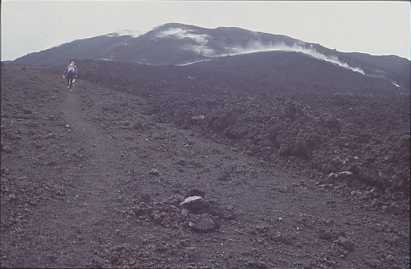
We reached the end of the road and found Arnold, a Dutchman waiting for company to climb Hekla. We had already decided we wouldn't have time to reach the summit and cycle back to Leirubakki, so his offer of a lift in his van was most welcome. We set off up the mountain, our feet leaving white snowy footprints as we pushed the black lava down into the snow. The new lava flow, last February, made things very difficult. It cut off the path. We tried crossing it, but it was very sharp and crumbly. We reached the top of the main climb, but after several attempts to reach the summit, we gave up. We just couldn't see a way through the new lava. So we descended, passing several large holes, which gave you the impression that if you fell into them, you'd never be seen again. We'd heard that in Iceland, people just disappear sometimes, and now we knew how.
On the way down, we met a group of French people who said the other half of their group had made the summit. Apparently, they'd had an Icelandic guide who four days earlier had spent all day looking for a way through the lava, and finally found one too late to get to the summit. So she'd come back today to guide the French guys and led them straight to it and onto the top.
On the way back we were following a cloud of dust, as you do in Iceland due to the dusty roads. Suddenly it was gone and there at the side of the road was a small 4x4 on its side. We stopped. The driver was just hauling himself out of the window. He said he'd just pulled over to give a passing car a bit more room when his wheels sank into the soft pumice and round he spun. He was a swimming pool manager from Paris - spoke almost no English and was travelling alone - quite courageous I thought as few people here speak French. He thought his fitness had helped him - he only received a small cut to his temple - it could have been far worse. A passing lorry helped as we all pushed to right the vehicle - its side looked as if it had been sanded with very coarse sandpaper. It was a lesson for all drivers in Iceland - never leave the road - the edges can be extremely soft.