
Iceland 2000
Around Reykjahlið, Lake Mývatn
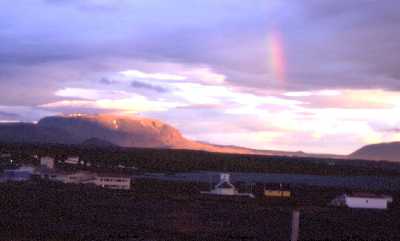
Wednesday, 19th July 2000:
In Akureyri, we met David and Christine from Brighton. They had been out for a little longer than us and had been up along one of the fjords north of Varmahlið in terrible winds. Somehow, however, they got the impression that we were some kind of "he-men" - super fit and prepared for anything. Nothing could have been further from the truth - neither of us had been on a serious cycle tour for about 12 years, and this was our most serious tour ever. They told us that Iceland was the worse place they'd ever cycled in. We asked where had been worst up until now, thinking they would say somewhere like northern Scotland. "Oh, the Xing Xiang pass in northern China was pretty difficult and some of the Himalayan passes were tough." Talk about he-men. They'd been everywhere!
We arrived before lunch in Reykjahlið and set up camp overlooking the lake. "Mývatn" means "Midge Water" so we didn't fancy the camp-site right down by the lake. We had no trouble with midges in late July.
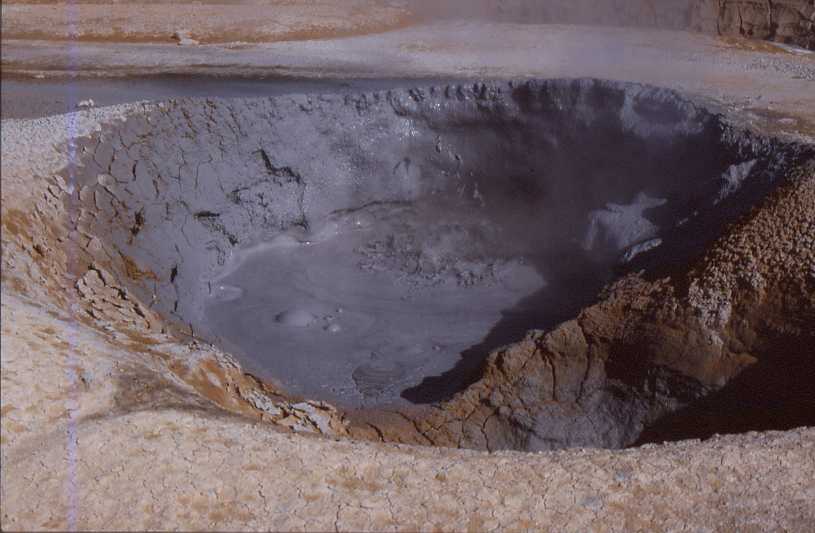 That afternoon we cycled east past the diatomite factory (See footnote if you want to know what diatomite is) over the hill to the thermal area near Námafjall. Here we encoutered boiling mud pools, and many steaming vents garnered by yellow sulphur crystals. This is the edge of the mid-Atlantic ridge. The hill we had just cycled over was in fact the mid-Atlantic ridge, and had a great cleft in its top to prove it. We had just cycled from the American Atlantic oceanic plate to the European plate in five minutes - that's faster than Concorde.
We turned off up to the volcanic area of Krafla ("f" is pronounced "p" in this word). Up past the geothermal power station to the water filled crater of Viti (means "Hell", not to be confused with the other Viti at Askja). Everything looked fabulous in the late afternoon sunshine. We walked up close to the two vents from the power station. Apparently when they hit the vent during the construction, the explosion was so violent it threw equipment 5km away. Miraculously no one was killed.
We walked from there into the lava field from the great rifting which took place in the early 1980s. A wide black strip stretched off into the distance in each direction, steam still rising from it in many places. Here the land was still alive. We walked for over an hour, jumping several times from Europe to America and back again.
It was nearly 9pm as we finally descended the mid-Atlantic ridge back into Reykjahlið. We were hungry. We decided to eat in the Gamli Bærinn, the "Old Farm" café of the Hotel Reynihlið. What a wonderful atmosphere here. Tourists from all over chatting about where they'd been and where they were planning to go. Locals too - this seemed to be "the" place to meet in an evening. The food was wonderful too - and plenty of it (even vegetarian dishes), and live music too by a Chris de Burgh lookalike pianist. We ended up eating here several nights.
Diatomite
Diatomite is a sedimentary rock, white to light yellow in colour, composed
of the fossilized skeletons of diatoms, one celled algae-like plants which
accumulates in marine or lacustrine environments. The honeycomb silica
structures gives diatomite useful characteristics such as high absorptive
capacity and surface area, chemical stability, and low bulk density.
Diatomite contains 90% SiO2 plus Al, Fe, Ca and Mg oxides.
There is much more info at the website of the Mývatn Research Station.
