Madagascar 2001
From Fianar to Ranohira
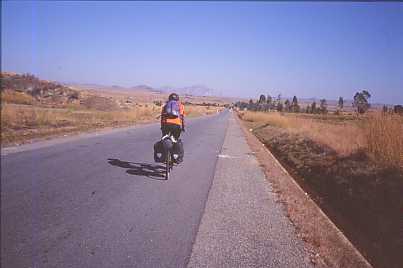
We had lunch at the rather grand Hotel de Bourganvilliers. The food was very good though we had to wait rather a while for it to arrive, which meant we didn't leave until nearly 3pm. Everywhere we passed through, people waved and shouted to us. In one village we cycled past, or rather through, a local football match. The spectators on our side had decided, rather than sit with their backs to the road, to sit on the other side, watching passers by too. Well, when three white "vasahas cycled through the village, the whole crowd erupting into cheering, and whistling - even the players stopped to wave to us! We felt like real celebrities.
Our rather late afternoon start meant the sun was getting low in the sky, casting an incredible golden light with long shadows across the beautiful landscape. After a wicked climb of a very long hill, we descended a little into the village of Isaha-Besoa. We decided it was time to stop. The light was fading and the mozzies were beginning to buzz around us. We pulled off the road and walked towards the small houses. We were trying to find the head of the village as our guide book had told us to always ask his permission before camping. Finally we found him and he said there was no problem. At first he thought we wanted a room, but we managed to explain that we had tents with us. It was actually the only night of the whole trip that we camped! By the time we had laid our bikes down there was a large crowd of villagers surrounding us, watching us. They were fascinated by our little pop-up houses, our really thin inflatable matresses, but most of all by our stove. Three times we had to ask if we could use the stove on the concrete area near the houses, and three times the head man asked us if we didn't think it was dangerous to light a fire near the house. When we turned the stove on and the orange flickering flames turned into a roaring blue burner there were gasps of wonder. They watched us cook, they watched us eat, and then finally decided they'd better let us go to bed in peace.
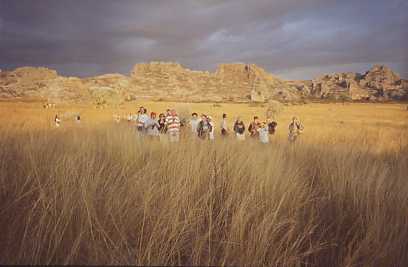
We woke early to get breakfast in before the crowds arrived. After taking a photo of the whole village and getting an address so we knew where to post it to (Isaha-Besoa), we set off. We stopped to buy oranges in the next village, where a sprightly old woman asked us in perfect French about our trip. She reminded me a lot of my grandmother. Shortly afterwards we reaped the rewards of that mean hill the previous evening. What a wonderful descent it was.
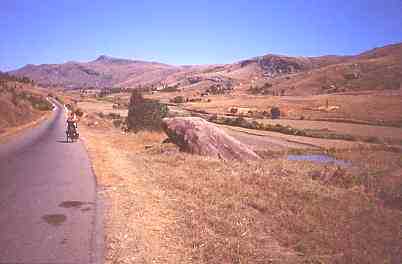
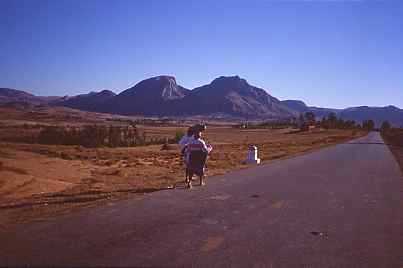
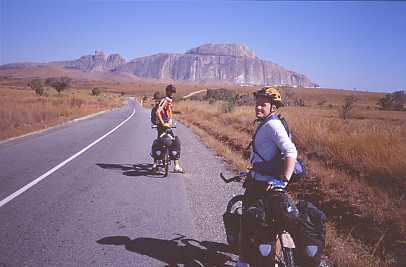
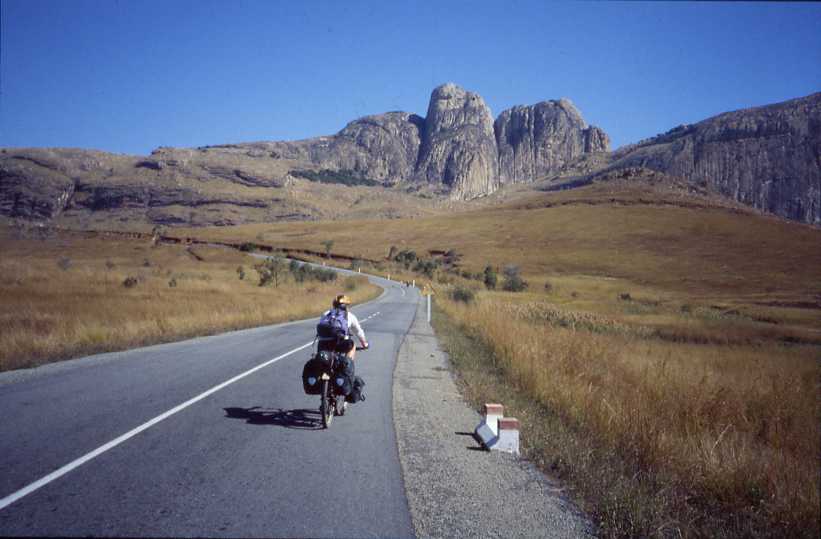
From here on the scenery became more and more impressive. The so-called "Bishop's Hat Rock" (or Pope's Hat Mountain) dominated for several miles, like a white version of Ayer's Rock. We were cheered on up the hill by a Baobab bus, "Sans Rival". It was a long day and the final section was across a mainly flat plane, past the small airfield and into Ihosy (pronounced "Ee-oosh"), where we stayed in the very pleasant Hotel Zahny.
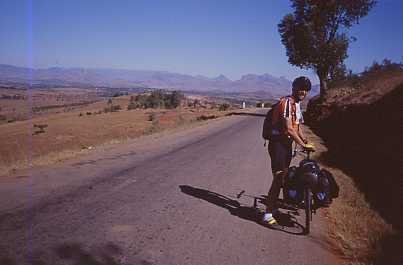
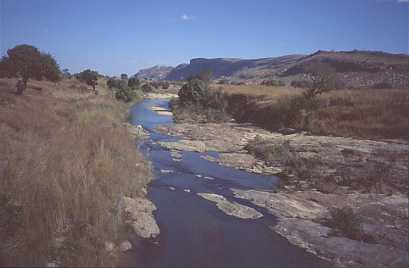
Tuesday started with a descent to the river bridge. We crossed the wide flat valley in which Ihosy lies, and headed towards the hills, which were very reminiscent of the English Lake District. The ascent was long, and after yesterday we felt very tired. Peter stayed back with Julian and I waited in the sunshine at a small roundabout at the top. Shortly afterwards, accompanied by a local lad in bare feet trying to keep up with us on his bike, we passed many market stalls being set up. This looked like a popular place to watch the eclipse from. But why weren't they going any further?, we thought. We soon found out.
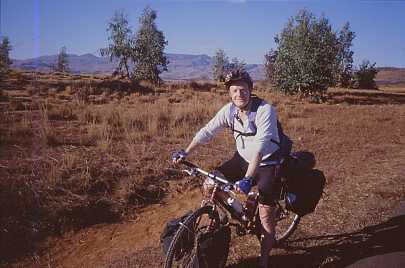
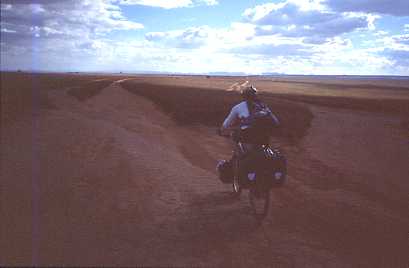
"Malvík Endar" is the sign they use in Iceland to denote the end of the asphalt section of road. They should have had one here. The tarmac turned into rough ochre sand, at times difficult to cycle on, but never impossible. As our confidence grew we cycled faster and faster, actually finding it fun to be sliding around expecting to fall off any second, but knowing that our great momentum meant that we would probably reach another firm section first. After five miles or so, we met a group of four French cyclists coming the other way - they were the first cycle-tourists we'd seen in our whole trip. We stopped to exchange news and information on the route. They assured us the sand stopped after another 5km - it actually turned out to be 15 to 20 miles. They had only seen one other cyclist - probably the one who arrived on our plane.
We stopped for a snack in a tiny village of only a few houses. A girl of 12 or so was grinding rice in a huge pestel and mortar. Some soldiers were drinking in what must have been the bar. One asked for some stomach pain tablets and we were happy to be able to help. The clouds slowly rolled in (oh, no) as we finally reached the end of the sand and were on metalled road once more. At the next village they were selling doughnuts - huge, delicious and very cheap doughnuts. Having not had a proper meal, we had several. A crowd gathered - did we have any solar glasses?, they asked. Well, we didn't, but I had some spare solar filter, and we found some cardboard on the ground - together with Peter's sellotape we made a pair of glasses. I described the whole event to a very knowledgeable teenager and told him how beautiful totality was. I stopped a man using an old crisp packet to view the Sun through - I hoped I got across the difference between the filter and the packet foil. We later heard they saw the whole event in this village.
Shortly afterwards, Julian had our first puncture of the tour. I continued on to try to find a hotel. I passed the Motel Isalo which looked like a building site, and headed into the centre. There I found the Baobab group sitting outside a pub. They were in the motel, but thought it may be full. I finally found a camp-site / bungalow park the other side of town. After hearing of the Dutch group's experience in the motel, I think we were better off were we were. The motel was struggling to cope with the huge numbers of visitors, and was very busy. We did make use of their restaurant though, and the food was excellent.