Madagascar 2001
From Tana to Fianar (via Ranomafana)
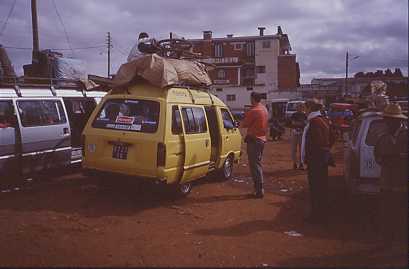
We took a taxi-brousse from Tana south to Antsirabe. There was no problem with bikes - they went on top of the luggage on the roof. Beware paying for extra seats - to the Malagasy there are more seats than you think. You may want to pay for that non-existent extra seat or they really will squash someone else in there!
We stayed in the Hotel Salamako in Antsirabe - very clean and grand, but not expensive and friendly too. We ate in what the Bradt guide described as "the best restaurant in Madagascar" - nothing that special. By the Hotel des Thermes we met two Dutch brothers who'd been stranded in Antsirabe during the war. They were lamenting the decline of this spa town since the French left the country.
Another taxi-brousse south beyond Ambositra to Ambohimasoa. "Do you really want to get out here?", asked the driver. We really did. We stayed in the Hotel Nirina ("You want to stay the night?", she asked) - basic but friendly and very cheap. No running water while we were there, though hot water was provided in the morning in a bucket. In the evening we walked around the village and met the local council officials. The mayor(?) told us, "Life is calm here. The RN7 passes... well, just here", he pointed behind the wall he was sitting on to the empty road - silence, "but, life is calm here", he smiled. "Makes a change from bustling Oxford", I thought.
The following morning we met a group of Poles - scientists on their way to the eclipse. They had just stopped at the hotel for coffee, and we realised this was what most people did. From the visitors' book we saw that the last guest had stayed there three months previously and that we were the only second foreign group since January 2000!
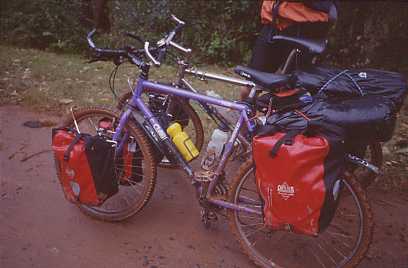
As we were about to leave, I discovered the bolt holding my front pannier carrier on had sheared and was stuck in the eye of my fork. A quick word with the guy at the petrol station and off someone went to fetch a mechanic. After a few minutes, another guy with a hand drill appeared. He tried with his broken drill bit to drill out the remaining parts of the bolt. A large crowd gathered. Who were these "vasahas" dressed in funny clothes on bikes? And what was all this fancy equipment on the bikes? Eventually the bolt fell out, the drill bit broke again in the eye and we were back to square one! A hammer and nail finally loosened the stuck drill bit and the eye was free. A hardware store down the road sold me a new bolt. I thanked the mechanic and offered to pay him for a new drill bit and his time. I gave him about £1.50 ($2.00) - he was delighted. And we were on our way at last.
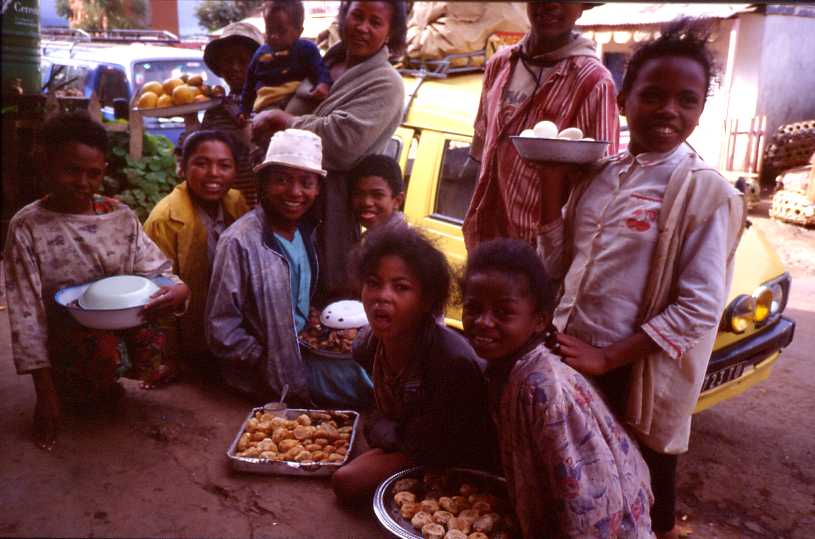
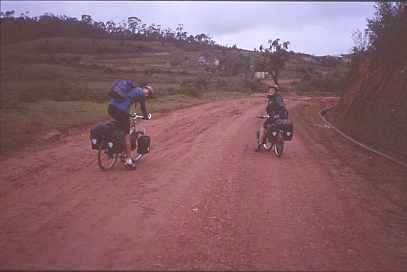
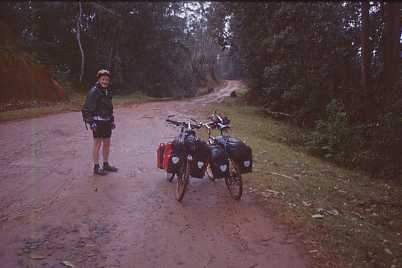
"You do realise that's a secondary road, don't you?" the mayor had said to us the evening before. We did. He told us the bridge was out, but we could get through on bikes. After five miles we found the road. Yes, it was rough, but fairly easy-going. We soon found the bridge - a twenty foot gap across the stream. It was bridged by two gutters just above the water level - one for us and one for the bikes! We bought snacks at the roadside - our first fried, battered vegetables. They were sold all over - two and a half pence each - or 5p if they realised you were rich foreigners (vasahas).
People greeted us from all directions. You'd think you were alone and then there'd be a shout from way across the fields. There would be a group of farm workers waving. Many of them were children - the girls with their mothers - both with babies on their backs; the boys with their fathers. It was the same throughout the country. I've never been greeted with such a friendly welcome anywhere I've been as we were in Madagascar. It really made a big impression on me. And everyone seemed to want eye contact with you. It was quite uplifting - you'd enter a village feeling tired, and by the time you left all those smiles and waves just gave you all the energy you needed. I felt as if I'd said "Salamo" to half the people we'd passed - and then felt guilty because I hadn't greeted the other half!
The road got worse - much worse. At times it really was a quagmire, but we managed to cycle almost all of it apart from a few hundred yards which was just too wet. When we finally met the "main road" we bought more fries and some coffee. Now it was downhill to the national park at Ranomafana, past the spectacular river gorge.
We stayed in the Hotel Manja in Ranomafana - straight on through the village and out the other side a few 100m. Great place - good food! This is where we met the first of the Dutch Baobab groups. We went on a night safari with them the first evening. Jean-Chrie was our guide who spoke good English. We saw a tiny mouse lemur and a red-bellied lemur, and also what the locals call a small "fossa", but apparently isn't really a fossa which is larger (it's Madagascar's largest carnivore - about the size of a large domestic cat).
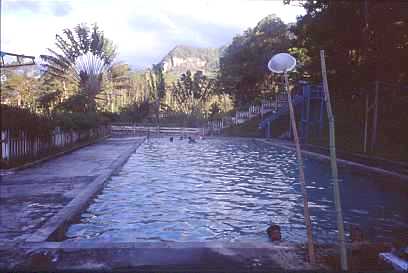
We went with him again the following morning on a long walk in the rain forest. Surprisingly it was sunny. We saw lots of lemurs of many different types. In the afternoon we went for a swim in the thermal baths at the now closed Hotel des Thermes. These were brilliant - hot, slightly sulphurous and very relaxing. That evening we met our second Baobab group and the Poles again.
The following morning we had a long climb out of Ranomafana, on our way to Fianarantsoa. We were going to take the "main road" which we were wondering if we should have taken on our way here. We shouldn't - it was as bad in places as the road we had taken. It took us 6 hours to get the 35 miles to Fianarantsoa. The last 10 miles were amazing - very fast on the smooth RN7 with everyone greeting us as if we were in the Tour de France!
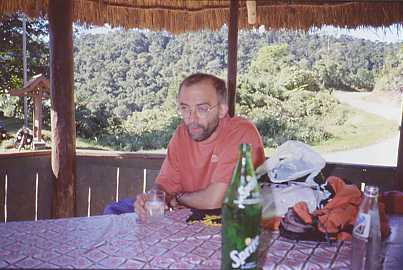
In Fianarantsoa, we stayed in the especially over-priced (for the eclipse) Hotel Cotsoyannis. Very clean and really excellent food. Highly recommended, especially outside eclipse-season. The first Baobab group were there too and we ate with them again.